
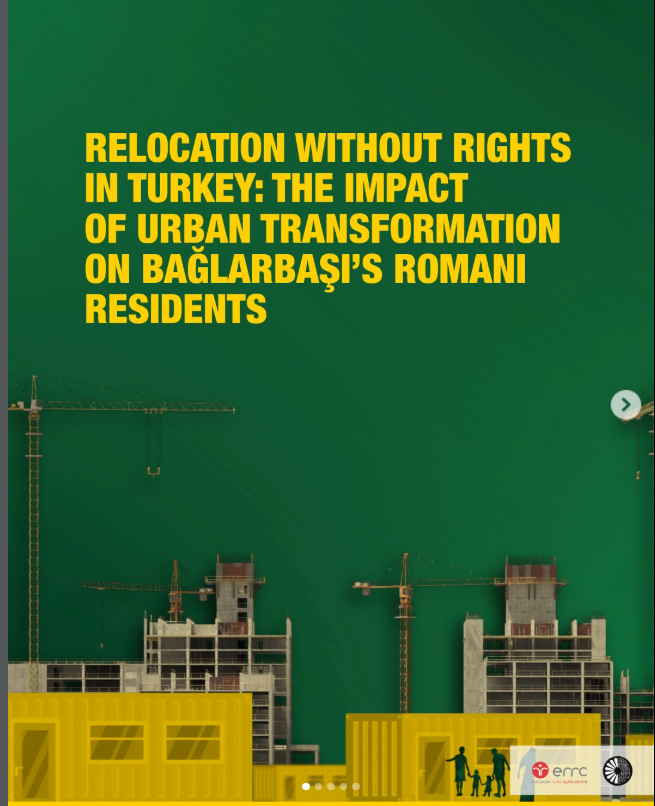
Our new report, “Relocation Without Rights in Turkey: The Impact of Urban Transformation on Bağlarbaşı’s Romani Residents,” prepared in collaboration between the Roma Memory Studies Association (Romani Godi) and the European Roma Rights Centre (ERRC), has been published.
This report examines the early stages of the urban transformation process in Bağlarbaşı Neighbourhood, located in the centre of Yalova. Known as the “balcony of Yalova” due to its view of the Marmara Sea, Bağlarbaşı is also an approximately 100-year-old Romani settlement. The study is based on in-depth field research and face-to-face interviews with residents.
Why Bağlarbaşı?
Bağlarbaşı Neighbourhood is more than a place of residence. As one of the oldest Romani neighbourhoods in Yalova, it is a vital living space that directly supports livelihoods, particularly for Roma working in sectors such as waste collection, music, and small-scale trade, and benefits from its proximity to the city centre.
However, prior to the urban transformation process, the neighbourhood was frequently associated with crime in the media, subjected to stigmatisation, and deprived of urban rights and public services for many years. This report analyses how such stigmatising narratives have been used to legitimise urban transformation projects and how they place the social and spatial memory of the Romani community at risk of erasure.
Field Findings: The Reality of the “Container City”
Between 17 December 2023 and 7 June 2024, Romani Godi conducted three separate field visits to both Bağlarbaşı Neighbourhood and the temporary prefabricated housing area in Çiftlikköy Sultaniye, where Romani residents were relocated. During this period, meetings were also held with Yalova Municipality and local Romani civil society organisations.
The findings reveal that, in addition to the concerns raised within the neighbourhood during the early stages of the urban transformation process, Romani residents living in the temporary prefabricated housing area were relocated to a site far from the city centre, without access to public transportation, and adjacent to former waste disposal sites and animal barns.
Key Findings of the Report Include:
- Environmental Risks: The prefabricated housing area is located on a former solid waste disposal site, and nearby livestock activities pose serious risks to public health.
- Energy Poverty: Due to the prohibition of stove use in prefabricated units, families face monthly electricity bills ranging between 3,000 and 5,000 TL.
- Security Concerns: In this isolated area with inadequate lighting, residents report fear of wild animal attacks, particularly at night.
- Uncertainty: There is a lack of transparent and regular information regarding the level of indebtedness beneficiaries will face for future housing and the timeline for the completion of the process.
Is a Rights-Based Urban Transformation Possible?
As Romani Godi, our primary goal is to ensure that Bağlarbaşı becomes a rights-based and inclusive “model urban transformation” for Turkey. However, this is only possible through the active participation of the Romani community in decision-making processes, the protection of property and housing rights, and the implementation of the principle of in-situ transformation.
At the end of the report, we present 14 key policy recommendations addressed to local authorities and the Ministry of Environment, Urbanisation and Climate Change, ranging from improvements in infrastructure services to support for education and employment.
This study is a strong call to prevent the repetition of past displacement experiences, from Sulukule to Küçükbakkalköy, in Bağlarbaşı.